Provinces are not costly; they are under-resourced relative to their constitutional responsibilities.
Khim Lal DevkotaPublished at : February 3, 2026Updated at : February 4, 2026 07:01
For several years, a dominant narrative in public discourse has portrayed federalism—particularly the provincial tier—as expensive, inefficient and fiscally burdensome. Provinces are often depicted as an unnecessary ‘middle layer’ that inflates administrative costs without delivering proportional public value. This claim is repeatedly echoed in political debates, media commentary and even some policy discussions, often without reference to consolidated fiscal data or constitutional intent.
A careful examination of actual public expenditure data, however, tells a different story. The evidence is unambiguous. Provinces account for a small share of total public spending, an even smaller share of salary and representative costs, and a disproportionately high share of capital expenditure. Far from being wasteful, provincial governments appear under-resourced, development-oriented and fiscally disciplined, operating within modest expenditure limits while carrying significant constitutional responsibilities.
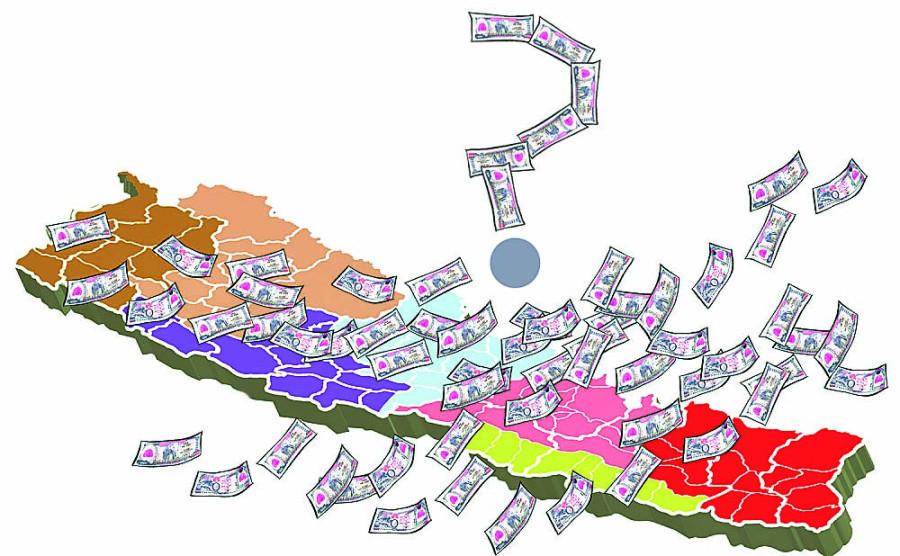
According to consolidated financial statements, total public expenditure of the three tiers of government in FY 2081/82 amounts to Rs21.49 trillion. After deducting double-counting among budgetary and non-budgetary entities, consolidated expenditure stands at Rs18.44 trillion. In gross terms, federal government expenditure, including financing, stands at Rs15.13 trillion. Provincial governments spent Rs1.98 trillion, while local governments spent Rs4.37 trillion. In proportional terms, the picture is striking. Of the total consolidated expenditure, the federal government accounts for 70.40 percent and local governments account for 20.35 percent. Provinces, by contrast, account for only about 9.25 percent, less than one-tenth of total public spending. If provinces were truly expensive, as commonly claimed, their expenditure share would be significantly higher. The data simply do not support the assertion that provinces are driving fiscal pressure.
Federalism in Nepal cannot be understood or evaluated through a purely fiscal lens. It emerged as a political and constitutional response to long-standing ethnic, class-based, regional, geographical, cultural and gender-based exclusions embedded in a highly centralised unitary state. The shift to federalism was intended to restructure state power by ensuring proportional and inclusive representation of all communities, languages and social groups across state institutions; to bring governance closer to citizens; and to dismantle excessive centralisation concentrated in Singha Durbar. At its core, federalism seeks to deepen democracy and ensure that the benefits of political change, development and public services are equitably shared by all citizens, not monopolised by the centre.
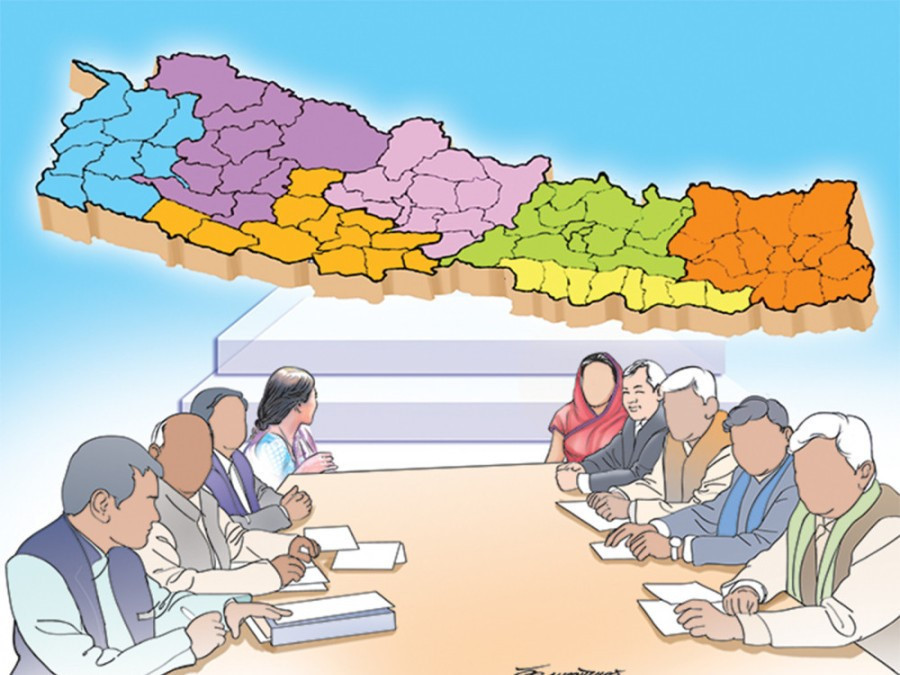
The provincial structure lies at the heart of this vision. Provinces are constitutionally designed to act as the bridge between federal policy and local service delivery; coordinating sectoral development, managing regional infrastructure and reflecting diversity in governance. Without functional and empowered provinces, federalism risks becoming hollow. Yet, despite clear constitutional intent, many development-oriented ministries, programmes and budget remain concentrated at the federal level. What appears as ‘small’ provincial expenditure is therefore less a reflection of inefficiency and more a consequence of incomplete devolution.
The strongest test of the claim that provinces are expensive lies in personnel-related expenditure. Critics often argue that provinces have added ministers, assemblies, bureaucracies and support staff, thereby inflating the state’s wage bill. The data again tells a different story. Total expenditure on salaries, allowances and benefits of officials and employees across all three tiers of government amounts to approximately Rs3.10 trillion. Of this, the federal government accounts for 50.47 percent. Local governments account for 44.84 percent. Provinces account for only 4.69 percent. Despite hosting provincial assemblies, councils of ministers, sectoral ministries and constitutional offices, provinces account for less than 5 percent of total personnel-related expenditure nationwide. If the provincial structure were fiscally bloated, its share of salaries would be visibly large. Instead, it is statistically negligible.
The same pattern holds across other recurrent expenditure categories. Nationwide expenditure on meeting allowances for officials amounts to Rs1.26 billion. Of this, provinces account for only 3.59 percent, compared to 89.71 percent for local governments and 6.70 percent for the federal government. Travel expenses nationwide amount to Rs3.30 billion, of which, provinces account for just 6.13 percent. Even in medicine procurement, national expenditure stands at Rs8.38 billion, with provinces accounting for only 10.04 percent. Across recurrent expenditure headings, the conclusion is consistent: Provincial spending remains modest and restrained.
The fiscal behaviour of provinces becomes even clearer when capital expenditure is examined. At the federal level, capital expenditure constitutes only 14.80 percent of total spending; remarkably low for a government that retains most fiscal authority and revenue. Federal expenditure remains heavily recurrent, driven by salaries, social security allowances, security and debt servicing. Provincial governments, by contrast, exhibit the opposite profile. As much as 60.86 percent of provincial expenditure is capital spending.
Provincial capital expenditure is largely directed towards long-term, development-oriented investments: construction of roads and bridges, irrigation systems, drinking water and sanitation infrastructure, embankments and flood control, electricity and public utilities, forest conservation and environmental protection and other essential public works. In public finance, this is sound fiscal behaviour. Rather than functioning as consumption-heavy bureaucracies, provinces are behaving like developmental governments; prioritising capital formation despite severe fiscal constraints. This alone should fundamentally challenge the narrative that provinces are wasteful or inefficient.
Another common misconception is that provinces merely duplicate local governments and therefore waste resources. A horizontal comparison across tiers suggests otherwise. Local governments naturally carry higher salary and service-delivery costs, reflecting their frontline role in education, health, sanitation and basic infrastructure. Provinces, by contrast, carry lighter personnel burdens but greater responsibility for coordination, regulation and provincial investment. This functional differentiation is not a flaw; it is precisely how a federal system is supposed to function.
Where duplication exists, it is largely the result of delayed federal framework laws, unclear functional assignments, and a centralised grant architecture that constrains provincial initiative. These are transition failures of the federal system, not inherent inefficiencies of provincial governments.
The most accurate conclusion drawn from the data is not that provinces are costly, but that they are under-resourced relative to their constitutional responsibilities. Despite having exclusive and concurrent powers, sectoral coordination roles and responsibility for provincial development, provinces receive a small share of total expenditure and an even smaller share of personnel resources. This creates a structural imbalance: high expectations, limited fiscal space, and constrained administrative capacity. Blaming provinces for this imbalance is analytically incorrect and politically misleading.
Public debate in Nepal has too often treated provincial governments as a fiscal liability. The evidence points in the opposite direction. With less than one-tenth of total public expenditure, a marginal share of salary and representative costs and a strong emphasis on capital investment, provinces are neither expensive nor fiscally irresponsible. They are a constrained but disciplined tier of government, operating on modest budgets while shouldering significant constitutional responsibilities.